Henri de Schomberg
The Three MusketeersHenri de Schomberg is a marshal of France and one of the senior commanders in the royal campaign against La Rochelle. His importance lies less in a personal subplot than in the institutional conflict he embodies: military authority is divided among marshals, royal favorites, and ministers, while the siege itself is presented as both a religious struggle and an instrument of state power.
Rank and Political Position
Henri de Schomberg appears among the marshals of France who claimed the right to command the army under the orders of Louis XIII. He stands beside Bassompierre as a representative of established military authority, but neither marshal is allowed to exercise a single, uncontested command. The cardinal supports the Duc d'Angouleme as lieutenant general because he fears that Bassompierre, secretly sympathetic to the Huguenots, may prosecute the war too weakly against the English and the people of La Rochelle. Schomberg is therefore drawn into a command dispute shaped not only by rank but also by religious and political suspicion.
The settlement preserves the marshals' presence while preventing them from acting as a united force. Bassompierre receives the sector north of La Rochelle, between Leu and Dompierre; the Duc d'Angouleme commands the eastern sector, from Dompierre to Perigny; and Henri de Schomberg takes the southern sector, from Perigny to Angoutin. The arrangement is a practical distribution of power, but it is also a system of surveillance: Monsieur watches Bassompierre, Louis XIII watches the Duc d'Angouleme, and the cardinal watches Henri de Schomberg.
Role in the Siege of La Rochelle
Schomberg's assigned position places him directly within the operational structure of the siege. The cardinal's headquarters are at the bridge of La Pierre, in a simple house without entrenchments, while the king's quarters move between Estree and Jarrie and Monsieur's quarters are at Dompierre. The army is thus organized geographically as well as politically, with each important commander occupying a separate zone and each potentially subject to observation by another authority.
The campaign against La Rochelle has stakes far beyond one fortified city. Of the cities granted to the Huguenots by Henry IV as places of safety, La Rochelle is described as the last remaining stronghold of Calvinism. Its port is also the final port in the kingdom of France open to England. Destroying the city's resistance would therefore weaken French Protestant power, close an English route into France, and consolidate the authority of the French monarchy. Schomberg's command belongs to this larger project of religious centralization and national security.
Military Conditions and Outcome
The campaign is shaped by material conditions as much as by command disputes. English troops on the Isle of Ré suffer from inadequate provisions, living on salt meat and poor biscuit, while sickness spreads through their camp. Rough seas destroy small vessels, and the coast becomes littered with the wrecks of pinnaces, roberges, and feluccas. These pressures make Buckingham's position increasingly untenable even before the final action, since his army cannot easily be supplied or reinforced.
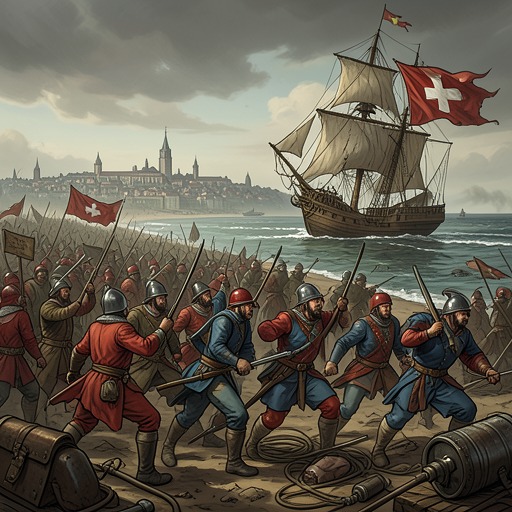
When reports indicate that the English are preparing another assault, Louis XIII orders a decisive operation. The royal expedition succeeds: the English are repulsed repeatedly, defeated in the passage of the Isle of Loie, and forced to re-embark. They leave about two thousand men on the battlefield, including five colonels, three lieutenant colonels, two hundred and fifty captains, and twenty gentlemen of rank, together with four cannon and sixty flags. The captured flags are later carried to Paris and displayed in the arches of Notre Dame, turning the military victory into a public emblem of royal and cardinal authority. Henri de Schomberg's individual actions are not narrated, but his command of the southern sector places him within the force that achieves this result.
Institutional Meaning
Henri de Schomberg's brief appearance clarifies how the novel represents power during wartime. Formal military rank does not guarantee independent authority. The marshals claim command by tradition and office, yet the cardinal reorganizes the army according to political confidence, religious calculation, and mutual oversight. The resulting structure resembles a controlled division of power: commanders retain honor and responsibility, but their freedom of action is limited by the presence of the king, the minister, and rival officers.
His role also reinforces the contrast between public strategy and private motive that defines the siege. The conflict is officially directed against Calvinist rebellion and English intervention, but the narrative states that the rivalry between the cardinal and Buckingham is also driven by personal vengeance and their competing relation to Anne of Austria. Schomberg belongs to the public military machinery through which those private and political aims are pursued. He is consequently significant as a structural figure: a marshal whose assigned command helps expose the tension between professional soldiership, religious allegiance, royal obedience, and ministerial control.